An example of computing Ligand SASA (solvent-accessible surface area) in protein pocket using RDKit
Published
February 4, 2021
Motivation
Solvent-accessible surface area (SASA) is an important descriptor in ligand binding. The extent of ligand SASA value decrease upon binding indicates whether the ligand is deeply buried or not upon binding to the pocket. RDKit provides SASA value calculation, which is based on FreeSASA package.
You appear to be running in JupyterLab (or JavaScript failed to load for some other reason). You need to install the 3dmol extension: jupyter labextension install jupyterlab_3dmol
Let’s define a function that compute SASA. The code is taken from here
from rdkit.Chem import rdFreeSASA# compute ligand SASAlig_h = Chem.AddHs(lig, addCoords=True)# Get Van der Waals radii (angstrom)ptable = Chem.GetPeriodicTable()radii = [ptable.GetRvdw(atom.GetAtomicNum()) for atom in lig_h.GetAtoms()]# Compute solvent accessible surface arealig_sasa = rdFreeSASA.CalcSASA(lig_h, radii)
# compute complex SASAcomp = Chem.CombineMols(prot, lig)comp_h = Chem.AddHs(comp, addCoords=True)# Get Van der Waals radii (angstrom)ptable = Chem.GetPeriodicTable()radii = [ptable.GetRvdw(atom.GetAtomicNum()) for atom in comp_h.GetAtoms()]# Compute solvent accessible surface areacomp_sasa = rdFreeSASA.CalcSASA(comp_h, radii)
print(lig_sasa, comp_sasa)
849.5659988403745 14213.44708409188
Note that comp_sasa is the overall SASA of both protein and ligand. We want to compute the SASA of ligand only while in the binding pocket. RDKit stores the per-atom SASA values in the atom object.
comp_lig = Chem.GetMolFrags(comp_h, asMols=True)[-1] # ligand is the last componentlig_sasa_free =0for a in lig_h.GetAtoms(): lig_sasa_free +=float(a.GetProp("SASA"))lig_sasa_bound =0for a in comp_lig.GetAtoms(): lig_sasa_bound +=float(a.GetProp("SASA"))
print("Ligand SASA (free) =", lig_sasa_free)print("Ligand SASA (bound) =", lig_sasa_bound)print("Ligand SASA difference =", lig_sasa_free - lig_sasa_bound)
Ligand SASA (free) = 849.5659988403745
Ligand SASA (bound) = 68.71464272335984
Ligand SASA difference = 780.8513561170147
Reduce computation time
Let’s put above in a functional call and measure the timing.
from rdkit.Chem import rdFreeSASAdef compute_sasa(mol):# Get Van der Waals radii (angstrom) ptable = Chem.GetPeriodicTable() radii = [ptable.GetRvdw(atom.GetAtomicNum()) for atom in mol.GetAtoms()]# Compute solvent accessible surface area sasa = rdFreeSASA.CalcSASA(mol, radii)return sasadef compute_ligand_sasa_pocket(prot, lig):# compute complex SASA comp = Chem.CombineMols(prot, lig) comp_h = Chem.AddHs(comp, addCoords=True) comp_sasa = compute_sasa(comp_h)# compute ligand SASA in pocket comp_lig = Chem.GetMolFrags(comp_h, asMols=True, sanitizeFrags=False)[-1] # ligand is the last component lig_sasa_bound =sum([float(a.GetProp("SASA")) for a in comp_lig.GetAtoms()])return lig_sasa_bound
sasa_free = compute_sasa(lig)sasa_bound = compute_ligand_sasa_pocket(prot, lig)print("Ligand SASA (free) =", sasa_free)print("Ligand SASA (bound) =", sasa_bound)print("Ligand SASA difference =", sasa_free - sasa_bound)
Ligand SASA (free) = 767.8208065148369
Ligand SASA (bound) = 68.71464272335984
Ligand SASA difference = 699.1061637914771
Let’s measure the timing of this function call. I suspect this is not particularly fast because the code needs to compute SASA of all protein atoms as well. Perhaps we can make this faster by only computing SASA within certain distance from the ligand atoms.
323 ms ± 1.39 ms per loop (mean ± std. dev. of 7 runs, 1 loop each)
def compute_ligand_sasa_pocket_cutoff(prot, lig, cutoff=8): lig_conf = lig.GetConformer() lig_xyz = lig_conf.GetPositions() prot_conf = prot.GetConformer() prot_xyz = conf.GetPositions()# minimum distance between protein atoms and ligand atoms r = np.min(np.linalg.norm(prot_xyz[:, np.newaxis, :] - lig_xyz[np.newaxis, :, :], axis=2), axis=1) indices = np.argwhere(r > cutoff).flatten() mol = Chem.RWMol(prot)for idx insorted(indices, reverse=True): mol.RemoveAtom(int(idx))return compute_ligand_sasa_pocket(mol, lig)
sasa_free = compute_sasa(lig)sasa_bound = compute_ligand_sasa_pocket_cutoff(prot, lig, 5)print("Ligand SASA (free) =", sasa_free)print("Ligand SASA (bound) =", sasa_bound)print("Ligand SASA difference =", sasa_free - sasa_bound)
Ligand SASA (free) = 767.8208065148369
Ligand SASA (bound) = 89.35880016654482
Ligand SASA difference = 678.4620063482921
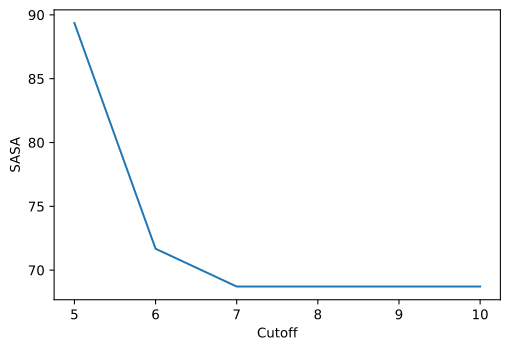
With the cutoff distance of 5 Å, we get slightly larger SASA value in the bound state. We can improve this by increasing the cutoff distance.
cutoff_values = [5, 6, 7, 8, 9, 10]sasa_bound_values = [compute_ligand_sasa_pocket_cutoff(prot, lig, c) for c in cutoff_values]plt.plot(cutoff_values, sasa_bound_values)plt.xlabel('Cutoff')plt.ylabel('SASA')plt.show()
The SASA value converged after 7 Å cutoff. Let’s compute the function call speed using 8 Å as cutoff.