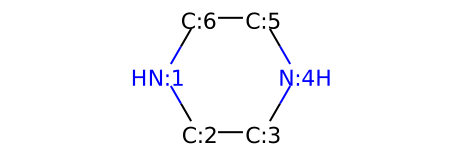
Examine ring conformation of piperazine built by RDKit ETKDG algorithm
Published
February 24, 2021
Motivation
I noticed whenever I built 3D conformers of molecules containing piperazine (or cyclohexane) using RDKit, I tend to get a distorted ring conformation. RDKit’s ETKDG (Experimental Torsion angle Knowledge-based Distance Geometry) algorithm works really well in general, but, in this case, it was not doing a good job at coming up with a reasonable initial conformation. I wanted to first quantify how much chair vs boat vs twisted conformer I get, so either I could use it to filter out non-desirable conformers or improve the RDKit’s conformer generation routine.
# atom mappingatoms = {a.GetAtomMapNum(): a.GetIdx() for a in mol.GetAtoms() if a.GetAtomMapNum() >0}# torsion angle atom indicestorsions = [ (atoms[1], atoms[2], atoms[3], atoms[4]), (atoms[2], atoms[3], atoms[4], atoms[5]), (atoms[3], atoms[4], atoms[5], atoms[6]), (atoms[4], atoms[5], atoms[6], atoms[1]), (atoms[5], atoms[6], atoms[1], atoms[2]), (atoms[6], atoms[1], atoms[2], atoms[3]),]
I’m going to define a simple check in chain vs boat vs twisted conformers of cyclohexane ring. If all six torsions are near +/- 60˚ (margin 30˚), it is considered a chair conformation. If two opposite torsions are close to 0˚ (margin 30˚) and the other remaining torsion angles are around +/- 60˚, then it is considered a boat conformation. The rest are considered as a twisted conformation.
So, I got 203 chair (40%), 18 boat (4%), and 279 twisted (56%) conformers. Let’s take a look at some conformers and make sure we got the right conformers. First chair conformation.
Code
from random import shuffleconf_idx = [i for i, c inenumerate(confs) if c =='chair']shuffle(conf_idx)viewer = py3Dmol.view(width=300, height=300)viewer.addModel(Chem.MolToMolBlock(mol_h, confId=conf_idx[0]), 'mol')viewer.setStyle({"stick":{}})viewer.zoomTo()viewer.show()
You appear to be running in JupyterLab (or JavaScript failed to load for some other reason). You need to install the 3dmol extension: jupyter labextension install jupyterlab_3dmol
And a boat conformation:
Code
from random import shuffleconf_idx = [i for i, c inenumerate(confs) if c =='boat']shuffle(conf_idx)viewer = py3Dmol.view(width=300, height=300)viewer.addModel(Chem.MolToMolBlock(mol_h, confId=conf_idx[0]), 'mol')viewer.setStyle({"stick":{}})viewer.zoomTo()viewer.show()
You appear to be running in JupyterLab (or JavaScript failed to load for some other reason). You need to install the 3dmol extension: jupyter labextension install jupyterlab_3dmol
And finally a twisted conformation:
Code
from random import shuffleconf_idx = [i for i, c inenumerate(confs) if c =='twisted']shuffle(conf_idx)viewer = py3Dmol.view(width=300, height=300)viewer.addModel(Chem.MolToMolBlock(mol_h, confId=conf_idx[0]), 'mol')viewer.setStyle({"stick":{}})viewer.zoomTo()viewer.show()
You appear to be running in JupyterLab (or JavaScript failed to load for some other reason). You need to install the 3dmol extension: jupyter labextension install jupyterlab_3dmol
Optimize Geometry using MMFF
Optimizing the Geometry using MMFF does the number of chair conformations and reduces twisted conformers.
for conf in mol_h.GetConformers():
    AllChem.MMFFOptimizeMolecule(mol_h, confId=conf.GetId())
Still about 50% of the conformers remain in the twisted conformation.
Code
from random import shuffleconf_idx = [i for i, c inenumerate(confs) if c =='twisted']shuffle(conf_idx)viewer = py3Dmol.view(width=300, height=300)viewer.addModel(Chem.MolToMolBlock(mol_h, confId=conf_idx[0]), 'mol')viewer.setStyle({"stick":{}})viewer.zoomTo()viewer.show()
You appear to be running in JupyterLab (or JavaScript failed to load for some other reason). You need to install the 3dmol extension: jupyter labextension install jupyterlab_3dmol
ETKDG version 3
I commented this issue on Greg’s blog and was suggested to try ETKDG version 3 algorithm [ref]. Here’s the result.
All 500 chair conformation even without doing minimization! But strange things were happening when I actually looked at some conformers. It appears the torsion angle requirements are all satisfied, but the ring was actually very much twisted.
Code
from random import shuffle#conf_idx = [i for i, c in enumerate(confs) if c == 'chair']#shuffle(conf_idx)conf_idx = [443]viewer = py3Dmol.view(width=300, height=300)viewer.addModel(Chem.MolToMolBlock(mol_h, confId=conf_idx[0]), 'mol')viewer.setStyle({"stick":{}})viewer.zoomTo()viewer.show()
You appear to be running in JupyterLab (or JavaScript failed to load for some other reason). You need to install the 3dmol extension: jupyter labextension install jupyterlab_3dmol
conf_idx =443conf = mol_h.GetConformer(conf_idx)angs = [Chem.rdMolTransforms.GetDihedralDeg(conf, *t) for t in torsions]print(angs)
In the six-membered ring, the signs of the torsion angle should alternate around positive and negative 60 degree. In my naive torsion angle check, I only checked if the absolute value of the torsion angles were around 60˚. However, in this case the torsion angles are arranged in around (-60, -60, +60, -60, -60, +60), which makes it twisted. Let’s count how many of these are in our conformers.
confs = []sums = []for conf in mol_h.GetConformers(): angs = np.array([Chem.rdMolTransforms.GetDihedralDeg(conf, *t) for t in torsions])# check if pos/neg values are alternating signs = angs / np.abs(angs)if np.sum(signs[1:] + signs[:-1]) ==0: confs.append('chair')else: confs.append('twisted')
Counter(confs)
Counter({'chair': 358, 'twisted': 142})
OK, so turns out, 358 (72%) of the conformers were actually in chair conformation and 142 (28%) of the conformers were in twisted conformers. Let’s take a look at some of the chair and twisted conformers.
Code
from random import shuffleconf_idx = [i for i, c inenumerate(confs) if c =='chair']shuffle(conf_idx)viewer = py3Dmol.view(width=300, height=300)viewer.addModel(Chem.MolToMolBlock(mol_h, confId=conf_idx[0]), 'mol')viewer.setStyle({"stick":{}})viewer.zoomTo()viewer.show()
You appear to be running in JupyterLab (or JavaScript failed to load for some other reason). You need to install the 3dmol extension: jupyter labextension install jupyterlab_3dmol
A twisted conformer:
Code
from random import shuffleconf_idx = [i for i, c inenumerate(confs) if c =='twisted']shuffle(conf_idx)viewer = py3Dmol.view(width=300, height=300)viewer.addModel(Chem.MolToMolBlock(mol_h, confId=conf_idx[0]), 'mol')viewer.setStyle({"stick":{}})viewer.zoomTo()viewer.show()
You appear to be running in JupyterLab (or JavaScript failed to load for some other reason). You need to install the 3dmol extension: jupyter labextension install jupyterlab_3dmol
Conclusion
I have used piperazine as an example because the molecule I was working had one, but I imagine cyclohexane may have the similar issue. The new ETKDG v3 algorithm does a good job getting chair conformation without FF optimization, but it could still produce seriously twisted conformers sometimes. User should check their conformer in such case with care before proceeding.
I have not looked into how RDKit’s ETKDG algorithm is implemented yet. If it is simple, I might be able to contribute. Otherwise, I can use the conformation checker I used here to filter out non-chair conformers.