# Atom feature sizes
MAX_ATOMIC_NUM = 100
ATOM_FEATURES = {
    'atomic_num': list(range(MAX_ATOMIC_NUM)),
    'degree': [0, 1, 2, 3, 4, 5],
    'formal_charge': [-1, -2, 1, 2, 0],
    'chiral_tag': [0, 1, 2, 3],
    'num_Hs': [0, 1, 2, 3, 4],
    'hybridization': [
        Chem.rdchem.HybridizationType.SP,
        Chem.rdchem.HybridizationType.SP2,
        Chem.rdchem.HybridizationType.SP3,
        Chem.rdchem.HybridizationType.SP3D,
        Chem.rdchem.HybridizationType.SP3D2
    ],
}

# Distance feature sizes
PATH_DISTANCE_BINS = list(range(10))
THREE_D_DISTANCE_MAX = 20
THREE_D_DISTANCE_STEP = 1
THREE_D_DISTANCE_BINS = list(range(0, THREE_D_DISTANCE_MAX + 1, THREE_D_DISTANCE_STEP))

# len(choices) + 1 to include room for uncommon values; + 2 at end for IsAromatic and mass
ATOM_FDIM = sum(len(choices) + 1 for choices in ATOM_FEATURES.values()) + 2
EXTRA_ATOM_FDIM = 0
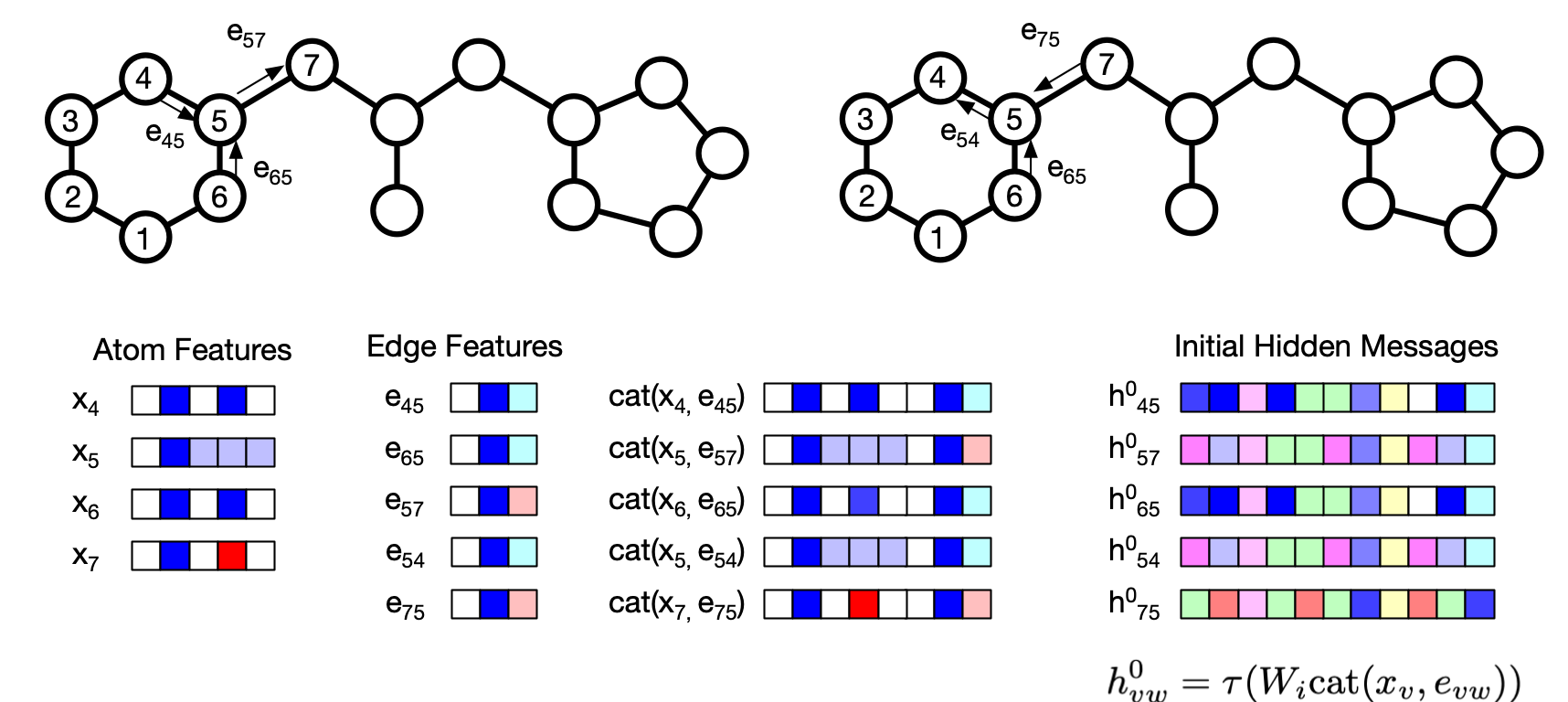
BOND_FDIM = 14


def get_atom_fdim() -> int:
    """Gets the dimensionality of the atom feature vector."""
    return ATOM_FDIM + EXTRA_ATOM_FDIM

def get_bond_fdim() -> int:
    """Gets the dimensionality of the bond feature vector.
    """
    return BOND_FDIM + get_atom_fdim()


def onek_encoding_unk(value: int, choices: List[int]) -> List[int]:
    encoding = [0] * (len(choices) + 1)
    index = choices.index(value) if value in choices else -1
    encoding[index] = 1

    return encoding

def atom_features(atom: Chem.rdchem.Atom, functional_groups: List[int] = None) -> List[Union[bool, int, float]]:
    """Builds a feature vector for an atom.
    """
    features = onek_encoding_unk(atom.GetAtomicNum() - 1, ATOM_FEATURES['atomic_num']) + \
               onek_encoding_unk(atom.GetTotalDegree(), ATOM_FEATURES['degree']) + \
               onek_encoding_unk(atom.GetFormalCharge(), ATOM_FEATURES['formal_charge']) + \
               onek_encoding_unk(int(atom.GetChiralTag()), ATOM_FEATURES['chiral_tag']) + \
               onek_encoding_unk(int(atom.GetTotalNumHs()), ATOM_FEATURES['num_Hs']) + \
               onek_encoding_unk(int(atom.GetHybridization()), ATOM_FEATURES['hybridization']) + \
               [1 if atom.GetIsAromatic() else 0] + \
               [atom.GetMass() * 0.01]  # scaled to about the same range as other features
    if functional_groups is not None:
        features += functional_groups
    return features


def initialize_weights(model: nn.Module) -> None:
    """Initializes the weights of a model in place.
    """
    for param in model.parameters():
        if param.dim() == 1:
            nn.init.constant_(param, 0)
        else:
            nn.init.xavier_normal_(param)

class MPNEncoder(nn.Module):
    def __init__(self, args, atom_fdim, bond_fdim):
        super(MPNEncoder, self).__init__()
        self.atom_fdim = atom_fdim
        self.bond_fdim = bond_fdim
        self.hidden_size = args.hidden_size
        self.bias = args.bias
        self.depth = args.depth
        self.dropout = args.dropout
        self.layers_per_message = 1
        self.undirected = False
        self.atom_messages = False
        self.device = args.device
        self.aggregation = args.aggregation
        self.aggregation_norm = args.aggregation_norm

        self.dropout_layer = nn.Dropout(p=self.dropout)
        self.act_func = nn.ReLU()
        self.cached_zero_vector = nn.Parameter(torch.zeros(self.hidden_size), requires_grad=False)

        # Input
        input_dim = self.bond_fdim
        self.W_i = nn.Linear(input_dim, self.hidden_size, bias=self.bias)
        w_h_input_size = self.hidden_size

        # Shared weight matrix across depths (default)
        self.W_h = nn.Linear(w_h_input_size, self.hidden_size, bias=self.bias)
        self.W_o = nn.Linear(self.atom_fdim + self.hidden_size, self.hidden_size)

    def forward(self, mol_graph):
        """Encodes a batch of molecular graphs.
        """
        f_atoms, f_bonds, a2b, b2a, b2revb, a_scope, b_scope = mol_graph.get_components()
        f_atoms, f_bonds, a2b, b2a, b2revb = f_atoms.to(self.device), f_bonds.to(self.device), a2b.to(self.device), b2a.to(self.device), b2revb.to(self.device)

        input = self.W_i(f_bonds)  # num_bonds x hidden_size
        message = self.act_func(input)  # num_bonds x hidden_size

        # Message passing
        for depth in range(self.depth - 1):
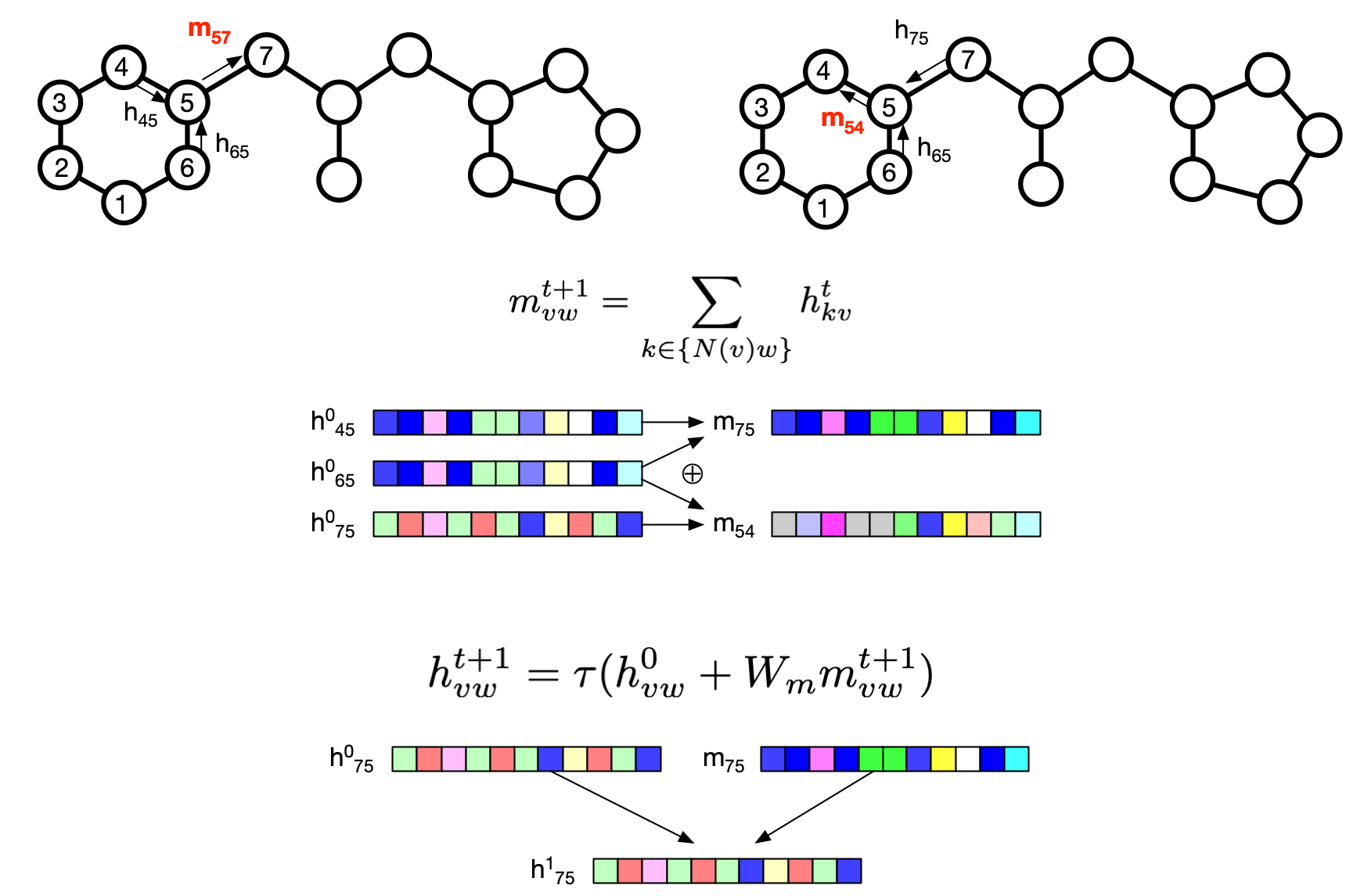
            # m(a1 -> a2) = [sum_{a0 \in nei(a1)} m(a0 -> a1)] - m(a2 -> a1)
            # message      a_message = sum(nei_a_message)      rev_message
            nei_a_message = index_select_ND(message, a2b)  # num_atoms x max_num_bonds x hidden
            a_message = nei_a_message.sum(dim=1)  # num_atoms x hidden
            rev_message = message[b2revb]  # num_bonds x hidden
            message = a_message[b2a] - rev_message  # num_bonds x hidden

            message = self.W_h(message)
            message = self.act_func(input + message)  # num_bonds x hidden_size
            message = self.dropout_layer(message)  # num_bonds x hidden

        a2x = a2b
        nei_a_message = index_select_ND(message, a2x)  # num_atoms x max_num_bonds x hidden
        a_message = nei_a_message.sum(dim=1)  # num_atoms x hidden
        a_input = torch.cat([f_atoms, a_message], dim=1)  # num_atoms x (atom_fdim + hidden)
        atom_hiddens = self.act_func(self.W_o(a_input))  # num_atoms x hidden
        atom_hiddens = self.dropout_layer(atom_hiddens)  # num_atoms x hidden

        # Readout
        mol_vecs = []
        for i, (a_start, a_size) in enumerate(a_scope):
            if a_size == 0:
                mol_vecs.append(self.cached_zero_vector)
            else:
                cur_hiddens = atom_hiddens.narrow(0, a_start, a_size)
                mol_vec = cur_hiddens  # (num_atoms, hidden_size)
                if self.aggregation == 'mean':
                    mol_vec = mol_vec.sum(dim=0) / a_size
                elif self.aggregation == 'sum':
                    mol_vec = mol_vec.sum(dim=0)
                elif self.aggregation == 'norm':
                    mol_vec = mol_vec.sum(dim=0) / self.aggregation_norm
                mol_vecs.append(mol_vec)

        mol_vecs = torch.stack(mol_vecs, dim=0)  # (num_molecules, hidden_size)

        return mol_vecs  # num_molecules x hidden


class MPN(nn.Module):
    def __init__(self, args, atom_fdim=None, bond_fdim=None):
        super(MPN, self).__init__()
        self.atom_fdim = atom_fdim or get_atom_fdim()
        self.bond_fdim = bond_fdim or get_bond_fdim()
        self.device = args.device
        self.encoder = MPNEncoder(args, self.atom_fdim, self.bond_fdim)

    def forward(self, batch):
        """Encodes a batch of molecules.
        """
        if type(batch[0]) != BatchMolGraph:
            batch = [mol2graph(b) for b in batch]

        encodings = [self.encoder(batch[0])]
        output = reduce(lambda x, y: torch.cat((x, y), dim=1), encodings)
        return output


class MoleculeModel(nn.Module):
    def __init__(self, args, featurizer=False):
        super(MoleculeModel, self).__init__()

        self.classification = args.dataset_type == 'classification'
        self.featurizer = featurizer

        self.output_size = args.num_tasks

        if self.classification:
            self.sigmoid = nn.Sigmoid()

        self.create_encoder(args)
        self.create_ffn(args)

        initialize_weights(self)

    def create_encoder(self, args):
        self.encoder = MPN(args)

    def create_ffn(self, args):
        first_linear_dim = args.hidden_size
        dropout = nn.Dropout(args.dropout)
        activation = nn.ReLU()

        # Create FFN layers
        if args.ffn_num_layers == 1:
            ffn = [
                dropout,
                nn.Linear(first_linear_dim, self.output_size)
            ]
        else:
            ffn = [
                dropout,
                nn.Linear(first_linear_dim, args.ffn_hidden_size)
            ]
            for _ in range(args.ffn_num_layers - 2):
                ffn.extend([
                    activation,
                    dropout,
                    nn.Linear(args.ffn_hidden_size, args.ffn_hidden_size),
                ])
            ffn.extend([
                activation,
                dropout,
                nn.Linear(args.ffn_hidden_size, self.output_size),
            ])

        # Create FFN model
        self.ffn = nn.Sequential(*ffn)

    def featurize(self, batch, features_batch=None, atom_descriptors_batch=None):
        """Computes feature vectors of the input by running the model except for the last layer.
        """
        return self.ffn[:-1](self.encoder(batch, features_batch, atom_descriptors_batch))

    def forward(self, batch):
        output = self.ffn(self.encoder(batch))

        # Don't apply sigmoid during training b/c using BCEWithLogitsLoss
        if self.classification and not self.training:
            output = self.sigmoid(output)

        return output